AI helps us sort information. It also gives us more to sort.

At 2 p.m., a request comes in through a private WhatsApp group, right in the middle of my workday. At 8:30 p.m., a message from my boss lands in the middle of my evening.
I've been on the receiving end of both.
Personal life spills into work. Work spills back into personal life. In between, the emails, news updates, and team messages keep coming.
The messages arrive one at a time. We have to fit them all into the same day.
Now we're adding conversations with AI to that already full day. We use it to reply faster, make sense of a document, or summarise what we haven't had time to read.
It helps. But does it leave us with less to process, or make it easier to take on even more?
More information, the same attention to go around
In my talks, I use a chart that tracks the volume of data created, captured, copied, and consumed worldwide. The growth is striking. IDC's 2026–2030 forecast, cited by Western Digital in September 2026, puts that volume at 274 zettabytes in 2026 and more than 718 in 2030. [1]
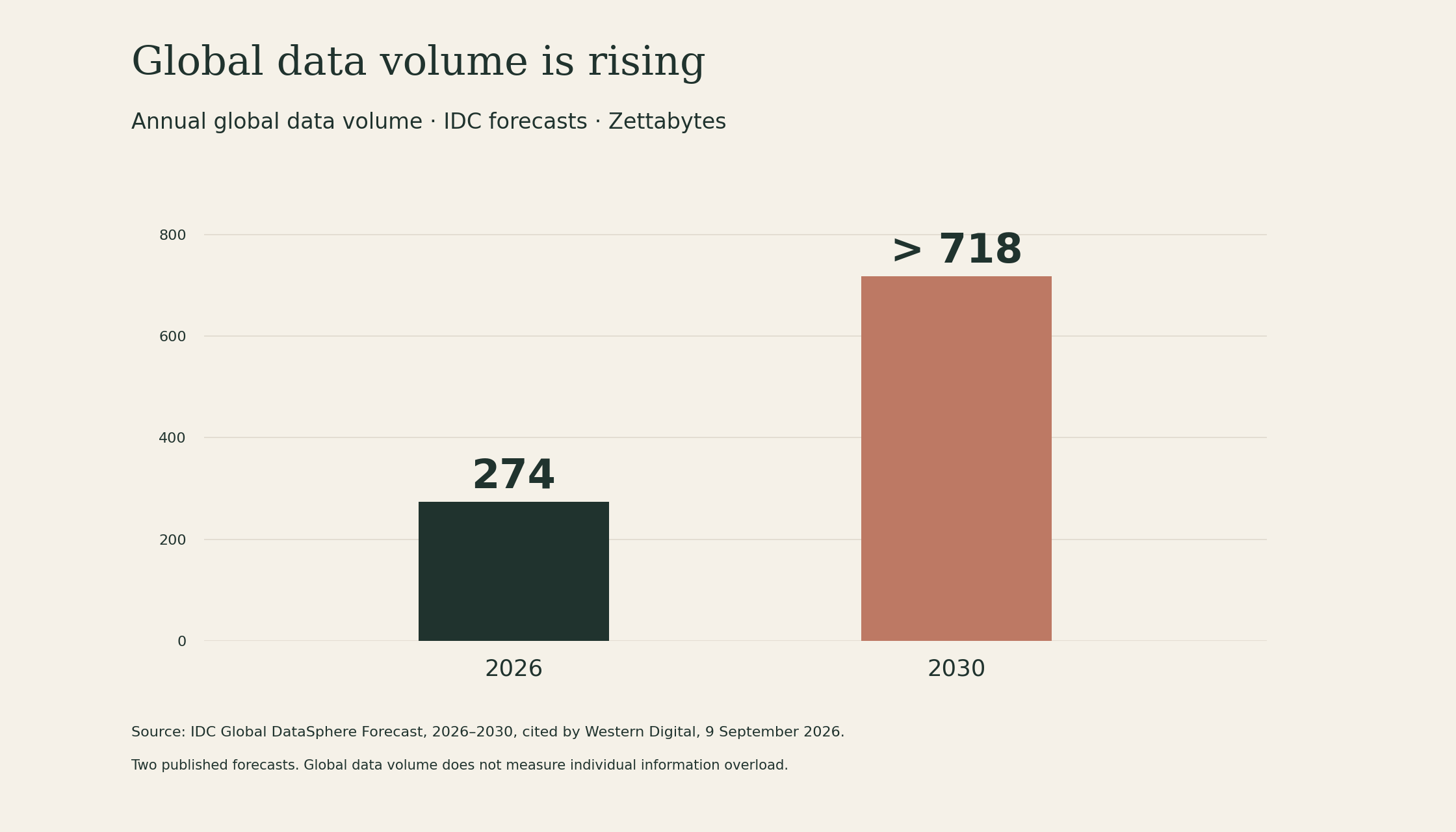
That volume includes copies and machine-generated data. It doesn’t tell us how many messages land in a working day.
For that, look at the inbox. In its June 2025 Work Trend Index, Microsoft reported that the Microsoft 365 users it studied received an average of 117 emails a day and 153 Teams messages per weekday. That gives us a sense of the traffic across two work channels. It isn’t an average for all workers. [2]
I opened the first article in this series with Herbert Simon. Here is how he put the problem in 1971:
“A wealth of information creates a poverty of attention.” [3]
Information can multiply. The time to read it and decide what to do with it doesn't.
Take a short message. Does it concern me? Do I need to reply? Can it wait? Sometimes I have to open it just to decide I can ignore it.
The cost is in what we read, and in everything we have to sort through along the way.
Reasonable requests. A day that can't hold them all.
That's what interests me about those two messages. A request in a private group at 2 p.m. may be perfectly fair. A manager can send a message at 8:30 p.m. without expecting an immediate reply.
But does the person receiving it know that?
The evening message can stay on your mind until morning. The afternoon one can interrupt a train of thought. And the other messages don't stop while you deal with either.
My own surveys show what happens to priorities. Of the 184 managers and employees surveyed in 2025, 82% said their digital workload slowed progress on their priorities. I shared that result in my first article. It reflects digital workload as a whole, including more than AI use. [4]
That result made me look beyond personal organisation and ask how teams decide what deserves a reply.
With AI, the stream becomes a conversation
AI can help with the sorting. It can make a complicated document clearer, narrow a search, or give us a summary that saves us from reading material we don't need.
It also changes how we get to information in the first place.
An answer prompts a follow-up. The follow-up brings up an angle you hadn't considered. You ask for an example, then a comparison. The subject gets more interesting. So you keep going.
Am I describing a problem or a pleasure? Both. That curiosity is part of what makes these tools useful. Each new avenue is also one more thing to consider.
And asking has never been easier: type it, say it out loud, or use the assistant built into the software you're already working in. It takes seconds to ask the next question. It takes longer to decide what to do with the answer.
Nobody pushed that information at you. You chose every piece of it. You can still end up with too much.

In my previous article, I wrote about the time it takes to make a presentation your own. Here, the question comes a little earlier: how much do we need to gather before we can start using it?
Overload is about more than volume
Better filters help. They only go so far.
In a 2023 review, Miriam Arnold and her colleagues examined ways to prevent and reduce information overload. They looked beyond individual habits to the information itself, the tasks people do, how work is organised, and the tools people use. [5]
Ten clear messages in one place can be easier to deal with than three conflicting requests scattered across different apps.
AI can make those three requests shorter. It can't tell you which one wins. If the priorities conflict, or nobody knows which version to use, the summary leaves that problem intact.
One thing to try: decide what counts as enough
Before your next search or conversation with AI, take a few seconds to finish this sentence:
“I'll have enough information to move forward when…”
When I can compare the two options. When I've checked that number. When I can explain my recommendation.
You can still explore. Having a stopping point in mind makes it easier to notice when you've left the original question and started on another.
Once you have what you need, use the answer before asking for another one. Write down your choice, or explain what you've understood. The other ideas can wait.
What if the team did some of the sorting too?
Setting a limit for yourself only gets you so far if the stream keeps growing around you.
If you're a manager, start with a simple question: what do I need the person receiving this to do? Read it, decide something, act on it, or simply know where to find it later?
The answer can change who gets the message, where you send it, and when you need a reply. Sometimes it means you don't send it at all.
The same test applies to AI-generated summaries, and here I'll be blunt. A summary that takes ten seconds to produce still takes someone's time to read. If nobody needs it to make a decision or take the next step, I'd keep it in my notes.
And for evening messages, make the expectation explicit so people don't have to guess. Sending a message at 8:30 p.m. and expecting a reply at 8:30 p.m. are two different decisions.
At 2 p.m. or 8:30 p.m., a message can reach us. We still have to decide what deserves our attention and what can wait.
For humans, with technology.
What about your organisation?
Do your teams need more information, or clearer rules for dealing with what's already coming in?
That's what I look at with teams and their leaders: the channels they use, the expectations around replies, how AI fits in, and what all of this means for their priorities. The Digital Attention Check-up helps you see where the friction is and choose three priorities for action, remotely, in three weeks.
Frequently asked questions
What is information overload?
It happens when there is more information to process than we can handle in a given situation. The amount matters, but so do its complexity and clarity, the time available, and the other things competing for our attention.
Does AI reduce information overload?
It can, by filtering or summarising. It can also give us more to review or prompt us to keep looking. The useful question is what it replaces and what it adds in a particular situation.
What can managers do?
Set clear priorities, agree on which channels to use, and make response times explicit. Before sharing something, clarify who needs it and what you expect them to do with it. Team agreements make it easier for individuals to decide what needs their attention.
Gabriel Pitt is a speaker, author of Be Present, and founder of OFF/ON®. He advises organisations on digital work, attention, and AI.
Sources and method
- IDC, Global DataSphere Forecast, 2026–2030, cited by Western Digital in The Next AI Challenge: Managing Data at Scale, September 9, 2026. Forecasts of 274 zettabytes for 2026 and more than 718 for 2030. The chart uses those two figures without filling in the intervening years. Global data volume includes copies and machine-generated data; it does not measure individual exposure or cognitive overload.
- Microsoft, Breaking down the infinite workday, 17 June 2025. Aggregated, anonymised Microsoft 365 usage data.
- Herbert A. Simon, “Designing Organizations for an Information-Rich World,” in Martin Greenberger (ed.), Computers, Communications, and the Public Interest, 1971. Herbert Simon archives.
- OFF/ON surveys, 184 managers and employees, 2025. Self-reported data from a nonrepresentative sample. The aggregated, anonymised finding on digital workload and priorities was first shared in the opening article of this series; it does not isolate the effect of AI.
- Arnold, M., Goldschmitt, M., and Rigotti, T. (2023). Dealing with information overload: a comprehensive review. Frontiers in Psychology, 14, 1122200. A review of prevention and intervention measures; it did not directly test the exercise suggested here or the effects of AI conversations.